Machine Learning, Deep Learning and Neural Networks: How They Actually Relate
These three terms get thrown around as if they mean the same thing. They don't. They're nested categories - like vehicles, cars, and sedans. Getting this straight changes how you read everything else about AI.
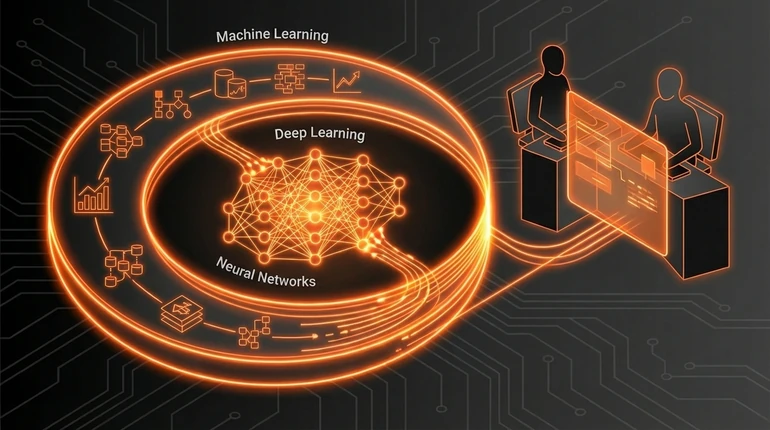

In this lesson
The Hierarchy: ML, Neural Networks, Deep Learning
Machine learning is the broadest term. It means any system that learns patterns from data instead of following explicit rules written by a developer.
If someone writes code that says "if email contains 'free money' flag as spam," that's a rule - not machine learning. If you feed the system thousands of emails and it learns what spam looks like, that's machine learning. Machine learning includes decision trees, random forests, linear regression, support vector machines, and neural networks. See the key ML algorithms lesson for a tour of these.
Neural networks are a subset of machine learning. Loosely inspired by how brains work (and only loosely), they consist of interconnected layers of simple processing units that learn to recognise patterns. Every neural network is machine learning. Not all machine learning uses neural networks.
Deep learning is neural networks with many layers. The word "deep" refers to depth - how many layers the network has. An older neural network might have 2-3 layers. A deep learning network might have 50, 100, or over 1,000. ChatGPT, image generation, self-driving cars - all deep learning.
Visually, the relationship looks like this:
MACHINE LEARNING (everything that learns from data)
├── Decision Trees
├── Random Forests
├── Support Vector Machines
├── Linear/Logistic Regression
└── NEURAL NETWORKS (interconnected layers)
    ├── Shallow Neural Networks (2-3 layers)
    └── DEEP LEARNING (many layers, usually 10+)
        ├── Convolutional Neural Networks (images)
        ├── Recurrent Neural Networks (sequences)
        ├── Transformers (language models)
        └── Diffusion Models (image generation)
Why the Confusion Exists
The terminology evolved historically, and some of the vagueness is deliberate.
In the 1980s, neural networks were a niche research area. When they came back in the 2010s - with more computing power and bigger datasets - people marketing these systems realised "neural networks" sounded better to investors than "machine learning." So they rebranded the same core idea as "deep learning" and made it sound revolutionary.
It's not wrong to say deep learning is a subset of neural networks, which is a subset of machine learning. But the terminology explosion - "artificial neural networks," "connectionist systems," "representation learning" - obscures the fact that it's the same fundamental idea with different marketing around it.
This matters in practice. When someone tells you they've built an "AI-powered" product, the useful question is: what's actually under the hood? A simple decision tree? A shallow neural network? A full deep learning system? All three get called "AI" or "machine learning." The labels don't help you understand what you're dealing with.
Why Layers Matter
A shallow neural network (2-3 layers) can learn simple patterns. It can draw curved lines between categories. Decent, not impressive.
A deep neural network learns hierarchical patterns. Earlier layers learn basic features. Later layers combine those into more complex ones. Higher layers work with increasingly abstract concepts.
In image recognition, the first layer might detect edges. The next detects corners and curves. The one after that detects shapes. Higher layers detect textures and patterns. The final layer says "this is a dog."
More layers mean more complexity can be learned. They also mean more parameters to tune, which means more data and computing power needed.
The breakthrough that made deep learning practical was finding that with the right techniques - specifically backpropagation and a function called ReLU activation - you could train networks with 50+ layers. Before that, training deep networks was effectively impossible. The maths didn't work: errors would shrink to nothing as they passed back through many layers, so early layers never learned. ReLU fixed this.
How This Maps to Modern AI
Everything impressive in AI right now is deep learning - specifically deep neural networks with specialised architectures.
Transformers power language models like ChatGPT and Claude. They're deep neural networks built for sequence data, using an attention mechanism that lets them weigh the relevance of different parts of an input when generating each output token. The "Attention Is All You Need" paper introduced this architecture in 2017.
Convolutional neural networks (CNNs) power image recognition. They're deep networks with filters that scan across an image, picking up spatial patterns regardless of where they appear.
Diffusion models power image generation tools like DALL-E and Midjourney. They're deep networks trained to reverse a noise process - starting from random pixels and gradually refining them into a coherent image.
When someone says "AI" in 2026, they almost always mean deep learning. When they say "machine learning," they might mean the broader category - which includes traditional techniques like random forests that still work well for many business problems - or they might mean deep learning specifically. Industry doesn't use these terms consistently.
My view: the confusion serves people selling AI services. Blurring the line between "we built a well-tuned decision tree" and "we have cutting-edge deep learning" is commercially useful if most of your customers won't notice the difference. If you're evaluating an AI system, push for specifics. The categories of AI lesson gives you the vocabulary to do that. Not all problems need deep learning. Sometimes a simpler approach is faster, cheaper, and more reliable.
Check your understanding
2 questions - select an answer then check it
Question 1 of 2
What does "deep" refer to in "deep learning"?
Question 2 of 2
Which combination of techniques made training deep neural networks (50+ layers) practical?