AI vs Augmented Intelligence: What's the Difference and Why It Matters
There are two very different stories people tell about the future of work. One says AI replaces humans at increasingly skilled tasks. The other says AI assists humans, making us better at what we do. Both are true - and framing matters far more than most people realise.

In this lesson
Augmented Intelligence Is an Actual Thing
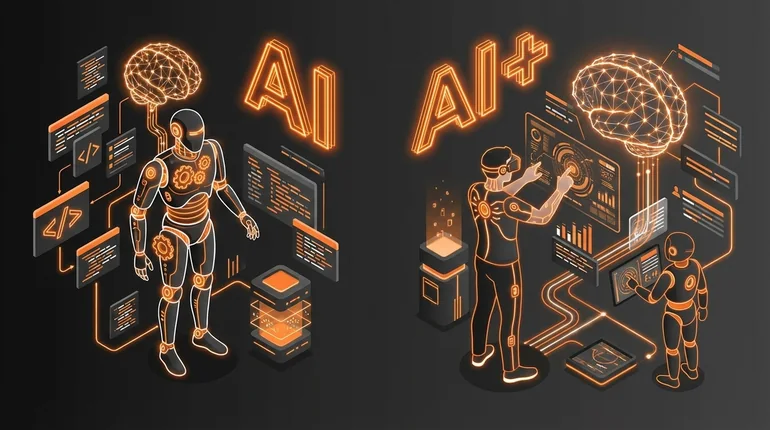
Augmented intelligence - sometimes called intelligence augmentation or IA - is using AI as a tool to extend human capability rather than replace human judgment.
When a radiologist uses AI to detect potential tumours in X-rays, that's augmented intelligence. The AI doesn't make the final diagnosis. It flags areas of concern and the radiologist decides. The radiologist uses pattern recognition at superhuman scale while keeping judgment and clinical context.
When a programmer uses GitHub Copilot to suggest the next lines of code, that's augmented intelligence. The programmer doesn't accept every suggestion - they evaluate, modify, accept what's right, reject what's wrong. When a lawyer uses AI to summarise depositions and flag potentially relevant precedents, the human still makes the legal argument.
The core idea is that humans and AI have different strengths. Humans are good at judgment, context, creativity, and deciding what matters. AI is good at finding patterns, processing volume, and consistency. Combine them and you get something better than either alone.
AI Replacement Is Also Real
Let's not pretend it's all augmentation. Some jobs are being replaced. Some tasks that humans used to do are now handled entirely by AI, with no human in the loop.
If you were a customer service representative answering the same questions repeatedly, chatbots are taking that work. If you transcribed audio to text professionally, speech-to-text systems took that work. If you wrote straightforward reports by following templates, text generation can do it faster.
This isn't intrinsically good or bad - it's real. Some work was tedious and worth automating. Some work employed people who needed those jobs. The gap between augmented intelligence and AI replacement depends on how the technology is deployed and what decisions people make about it. The technology itself is usually identical.
How They Actually Differ in Practice
The difference isn't in the technology. It's in deployment.
A language model could be deployed as a chatbot that answers customer questions with no human review (replacement). Or it could draft responses that a human customer service agent reviews, edits, and sends (augmentation). An image recognition system could automatically remove content without human review (replacement), or flag content for human moderators to examine (augmentation). A medical diagnostic system could make autonomous treatment recommendations (replacement), or flag areas for doctors to investigate (augmentation).
The technology is identical. The deployment is different.
Augmented intelligence keeps humans in the decision loop - the AI suggests, recommends, highlights, or processes, and the human decides. AI replacement takes the human out of the loop. This is faster and cheaper if the AI is accurate enough. It's also riskier because there's no catch for mistakes.
Why the Framing Is Often Dishonest
Here's my actual view: the "augmented intelligence" framing is often just a better story, not a reflection of what's actually happening.
Companies say they're using augmented intelligence while building systems that phase humans out. A company might genuinely believe they're augmenting radiologists while gradually reducing the time radiologists spend reviewing AI outputs. Then the AI makes mistakes and nobody was actually checking most of the output.
It's not always deliberate dishonesty. Human review is expensive and is a friction point. If the AI is 95% accurate, companies ask why they need human review. Then it becomes 90% accuracy in production and that 10% of errors compounds.
Genuine augmented intelligence requires: the human can actually evaluate the AI's output; the human has time and incentive to do so properly; the system is designed so humans aren't just rubber-stamping what the AI suggests; and when the AI fails, the failure is visible and gets corrected.
That third point is critical. Humans are bad at saying no to automation suggestions when the suggestion is usually right. We get lazy. We start trusting it. That's not augmentation - that's replacement with a human label on top. The lesson on AI failures and ethics covers what happens when this goes wrong at scale.
The Real Question To Ask
The real question isn't "is this augmentation or replacement?" It's "who benefits and who bears the risk?"
A radiologist reviewing AI-flagged X-rays catches cancer earlier and faster. The radiologist's expertise is enhanced and the patient gets better care. That's win-win.
A call centre worker whose job is just reviewing AI-generated responses to make sure they're not offensive, while the team shrinks by 70%, is replacement with a better narrative.
Both use the same technology. The difference is in deployment, incentives, and who decided what success looks like.
If someone tells you a technology will augment work, ask: how concretely does the human stay in the loop? Who decides when the AI is wrong? What prevents humans from becoming decorative? Those answers tell you whether it's genuine augmented intelligence or just replacement with better branding.
Check your understanding
2 questions - select an answer then check it
Question 1 of 2
A company deploys the same language model in two ways: one answers customers with no human review; the other drafts responses for a human agent to review and send. Which statement is correct?
Question 2 of 2
According to the lesson, what makes humans ineffective at genuine oversight in augmented intelligence systems?