Real-World AI Failures and Why Ethics in AI Actually Matter
AI companies talk about breakthroughs. They don't advertise the times their systems failed spectacularly and hurt real people. This lesson covers documented failures, the accountability gap they expose, and what genuine ethics in AI requires.
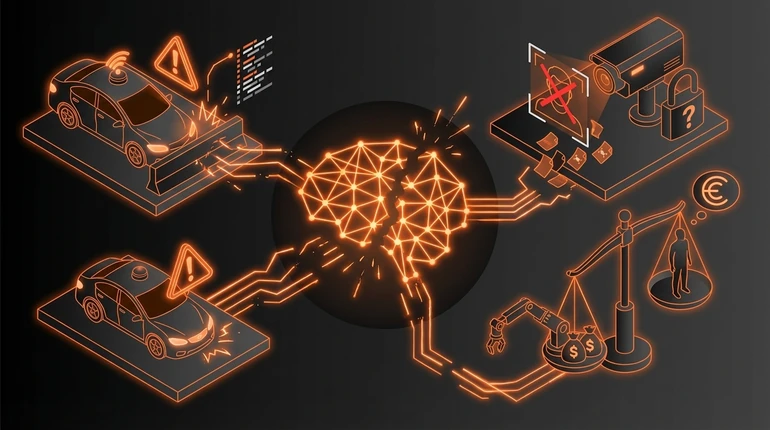

In this lesson
The Concrete Problems
In 2020, an innocent Black man was arrested in Detroit because the police department's facial recognition system misidentified him. The technology had a documented error rate of around 35% when identifying Black faces, compared to less than 1% for white faces. This wasn't a philosophical debate about bias - it was a person spending hours in jail for something an algorithm got wrong.
Amazon's hiring algorithm, built in 2014, was trained on historical hiring data from an industry (tech) that's massively male-dominated. The system learned that pattern and started automatically downranking female applicants' resumes. Amazon scrapped it eventually, but only after the problem became public. How many qualified women didn't get a chance before then?
Medical AI has similar problems. A widely-used algorithm for allocating healthcare resources systematically recommended fewer services to Black patients because it used healthcare spending as a proxy for need. Sicker patients cost more to treat. Since Black Americans face systemic barriers to healthcare access, they spent less - so the algorithm concluded they needed less help. The mathematical logic was sound. The results were discriminatory.
Why "The AI Made a Mistake" Isn't an Excuse
When a human makes a bad hiring decision, they're accountable. When a doctor misdiagnoses a patient, there's a paper trail and responsibility. When an algorithm does it, suddenly everyone's hands are clean.
"The AI made the decision" gets treated like an act of nature rather than the act of people who built it, trained it, deployed it, and chose not to audit it properly. This is a direct consequence of how AI systems are built - and the opacity that follows. Companies use opacity as a shield. They can say "it's too complex to explain why it failed" when what they really mean is "we didn't think hard about whether it would work fairly."
Amazon retired its hiring algorithm with a quiet press release. Detroit's police department faced some scrutiny. The man who was arrested had to prove his innocence. The accountability is almost entirely one-directional: towards the person harmed, not towards the organisation that deployed the system.
The Gap Between "AI Said So" and Accountability
A loan approval system denies you credit. Can you ask why? Usually not. There's no equivalent to asking a human loan officer to justify their decision. When an AI's decision affects your life and you can't appeal to any logic, something's broken about how we're using these tools.
Medical devices are slightly better because of regulatory oversight, but not by much. A hospital implements an algorithm validated on one dataset, then uses it on a different population. When outcomes are worse, who's liable? The algorithm developer? The hospital? Nobody's figured that out yet.
Companies love AI's plausible deniability. They can say "we didn't program it to discriminate" - and technically, they didn't. The system learned discrimination from the data. That's both true and completely insufficient as an excuse. The hallucinations and bias lesson covers the mechanics of how this happens. The people who chose the training data, chose not to audit for demographic disparities, and chose to deploy anyway - they made decisions.
What Companies Are Actually Doing
Some organisations have started taking this seriously. Microsoft published a responsible AI playbook. Google made bias detection tools public. The AI governance frameworks lesson covers what regulation is actually doing about this. Better than nothing. But better than nothing isn't good.
Most companies still treat ethics as a PR move, not a design requirement. They audit models after deployment rather than before. They talk about transparency while keeping training data proprietary. They hire ethics teams and then ignore them when there's a deadline.
Deploying an AI system that affects people's opportunities, health, or freedom without rigorous bias testing should be treated the same way as using an untested drug on patients. It isn't. Companies get years of market advantage before anyone holds them accountable. By then, the biased decisions have affected thousands of people and become normalised.
Real ethics in AI means building slower, testing harder, and accepting that sometimes you don't deploy because the risk is too high. It means admitting when you don't know if something works fairly. I'm sceptical that happens on its own without external pressure - regulatory or otherwise.
Check your understanding
2 questions - select an answer then check it
Question 1 of 2
Why did Amazon's hiring algorithm downrank female applicants?
Question 2 of 2
What does the "accountability gap" in AI mean?