AI in 2026: How Large Language Models Are Reshaping Search, Content and the Way We Work
Large language models have shifted from novelty to infrastructure. From AI Overviews in Google Search to tools that write, code and analyse - here is what that shift looks like in practice, and what it means for anyone building, marketing or operating online.


menu_book In this article expand_more
Two years ago, asking an AI to write a compliance disclaimer, summarise a YouTube video or generate structured data for a website felt like a novelty - something you might show colleagues as a curiosity. Today those same tasks are part of normal workflows for marketers, developers and operators across most industries. The shift has happened faster than most predicted and it is not slowing down.
This article looks at where AI - specifically large language models - actually sits in 2026, what has changed in search and content, and what people working in digital, iGaming and technology need to be paying attention to.
Search has already changed
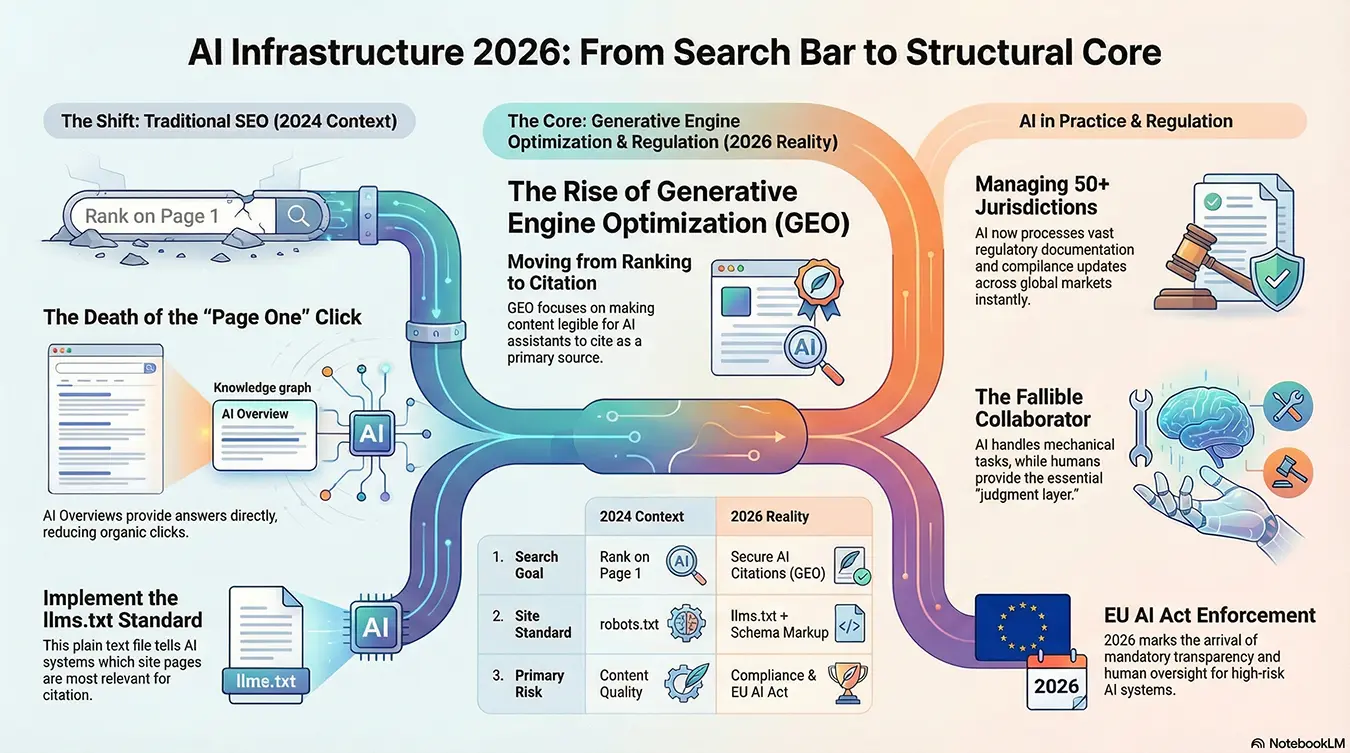
Google's AI Overviews, rolled out broadly through 2024 and now a standard part of search results, represent the most visible shift. For many queries - especially informational ones - users now get a synthesised AI-written answer at the top of the page before they see any organic results. Perplexity has built an entire product around this model. ChatGPT's search integration means OpenAI is now a direct competitor to Google for information retrieval.
The practical consequence is that the old model of "rank on page one, get clicks" is being disrupted. A site can rank highly and still receive fewer clicks because the answer has already been provided. This is not a future risk - it is happening now, and the traffic data from 2025 onwards shows it clearly in informational content categories.
This does not mean SEO is dead. It means the goal has shifted. The question is no longer just "can Google find and rank my content?" but "will AI assistants reference, cite and link to my content when answering related questions?" That is a different optimisation problem - and it has a name.
GEO: generative engine optimisation
Generative Engine Optimisation (GEO) is the emerging discipline of making your content and website structure legible to AI systems - not just search crawlers. The aim is to be the source that an AI assistant cites or links to when answering a question in your domain.
Some of the practical elements of GEO include:
- Structured, authoritative content - AI systems tend to cite sources that answer questions clearly, directly and with specificity. Vague or thin content is less likely to be surfaced.
- Schema markup - Machine-readable structured data helps AI systems understand what a page is about and who produced it.
- The llms.txt standard - Proposed in 2024 and gaining adoption, a plain text file at your site root (
yourdomain.com/llms.txt) tells AI systems what your site contains and which pages are most relevant. It is the GEO equivalent of robots.txt. You can generate one instantly with the LLMs.txt Generator. - Brand and entity consistency - Appearing consistently across authoritative sources (LinkedIn, GitHub, industry publications) helps AI models build a reliable representation of who you are and what you do.
GEO is still early. There is no equivalent of Google Search Console for AI citation tracking yet. But the groundwork you lay now - structured content, clear authorship, llms.txt, schema - will matter as AI search matures.
AI at work: what has actually changed day to day
Beyond search, the more significant shift for most knowledge workers is in how AI has embedded itself into daily tasks. Three areas stand out.
Writing and content
The gap between "AI wrote this" and "a human wrote this" has narrowed considerably, but it has not closed. What AI is genuinely useful for in content work is the structural and mechanical parts - drafts, outlines, variations, first-pass editing, formatting. The judgement layer - what angle to take, what to leave out, what a specific audience actually cares about - still requires a human. Tools like the AI Copyeditor are built specifically for this - handling the mechanical editing pass while leaving the judgement to you.
In regulated industries like iGaming, this matters more. A model that does not know the current UKGC advertising standards or the KSA's latest social media guidance will confidently generate copy that fails compliance review. AI is a useful drafting assistant here, not a replacement for a compliance team.
Code and development
Coding assistance is the most mature AI use case by some margin. Tools like GitHub Copilot, Claude Code and Cursor have meaningfully changed the pace at which developers can work, particularly for boilerplate, repetitive patterns and documentation. The productivity gains are real for experienced developers; the risks are also real for those who accept AI-generated code without understanding it.
The practical upside for small operations or solo builders is significant - it is now realistic to build and maintain tools that would previously have required a larger team or budget. Most of the tools on this site are built that way - see the LLM Chat tool for a direct comparison of Claude, OpenAI and Gemini side by side.
Data and analysis
AI's ability to read, summarise and extract structure from large volumes of text is one of its most underused capabilities in many organisations. Regulatory documents, competitor content, customer feedback, support logs - these are all things that a model can process and surface patterns from at a speed that was not previously practical. The output still needs human judgement, but the time cost of the initial analysis has dropped dramatically.
AI in iGaming specifically
The iGaming industry has specific characteristics that make AI both more useful and more risky than in some other sectors.
On the useful side: the volume of regulatory documentation across 50-plus jurisdictions is enormous. AI can help compliance teams process updates, cross-reference requirements and draft initial summaries far faster than manual review. Promotional copy generation, responsible gambling messaging, player communication - all of these have genuine AI applications. The iGaming Compliance Map covers 203 regulations across 60-plus jurisdictions for reference.
On the risk side: the same compliance environment means that errors carry real consequences. A marketing claim that fails ASA guidelines, a bonus structure that breaches UKGC rules, a data handling process that violates GDPR - these are not abstract risks. Any AI-assisted workflow in iGaming needs a robust human review layer, and the AI tooling needs to be built with those constraints in mind rather than around them.
What to watch in the second half of 2026
A few developments worth tracking:
- AI agents - Models that do not just respond to prompts but take sequences of actions autonomously are moving from demos to real products. The implications for workflows that currently require human coordination are significant.
- Multimodal models - The ability to reason across text, images, documents and data in a single context is becoming standard rather than exceptional. This changes what you can hand off to an AI and what context you need to provide.
- EU AI Act implementation - The compliance deadlines are arriving. High-risk AI system classifications, transparency requirements and human oversight obligations will start affecting how AI tools are built and documented in EU-regulated industries, including iGaming.
- Search citation transparency - There is growing pressure on AI search providers to be clearer about which sources they are drawing from. How this plays out will have significant implications for content strategy and GEO.
The practical takeaway
AI is not going to transform everything overnight, and it is not a solution to problems that require domain expertise, regulatory knowledge or genuine judgement. What it does do is reduce the cost and time of certain categories of work substantially - and those savings compound when applied consistently over time.
The people and organisations that will benefit most are those who treat AI as a capable but fallible collaborator rather than an authority - one that can accelerate work but whose outputs need to be understood, reviewed and taken responsibility for by the people deploying them.
That is not a particularly exciting conclusion. But it is the accurate one. If you want to explore any of the tools mentioned, the full list is on the homepage - or start with the LLM Chat to compare models directly.