What Happens When Your AI Songs Get 88 Million Views
I generated 88 million streams with AI music in 2024-2026. Here's what I actually made—and why I won't share the songs.

In this article expand_more
In 2024, I decided to try AI music generation using Suno. It seemed like a silly idea at the time - generate some tracks, upload them somewhere, see what happens. I wasn't expecting much. What actually happened was both surprising and a cautionary tale about the gap between reach and reward.
This is the story of 88 million views, 60 AI-generated tracks, and the punchline you're probably already guessing at.
The Setup: Why AI Music Generation?
Suno is a generative AI music tool. You describe what you want - genre, mood, vibe - and it generates a full track. No musical knowledge required. In January 2024, I was curious. Could this actually produce something listenable? Would anyone care if I uploaded it?
I had low expectations. I generated about 60 tracks over a few months. The music was... let's say experimental. Rough. In some cases, genuinely embarrassing. But I uploaded everything to SoundON Global anyway, a music distribution platform for independent artists.
I wasn't expecting anything. That was my baseline. Which meant reality had nowhere to go but up.
Distribution: SoundON Global
SoundON Global is a music distribution service that gets your tracks onto Spotify, Apple Music, YouTube Music, and other major platforms. You upload once, it handles the rest. The premise is simple: more distribution channels, more potential listeners, more streaming revenue.
I uploaded my 60 tracks and set them loose. No marketing, no promotion, no expectation, and no thought given to how AI systems decide what to surface. I'd check the numbers occasionally - a few hundred views here, a thousand there. Nothing remarkable. I genuinely thought that would be it.
Then something shifted.
The Long Game: Views Accumulating Over Time
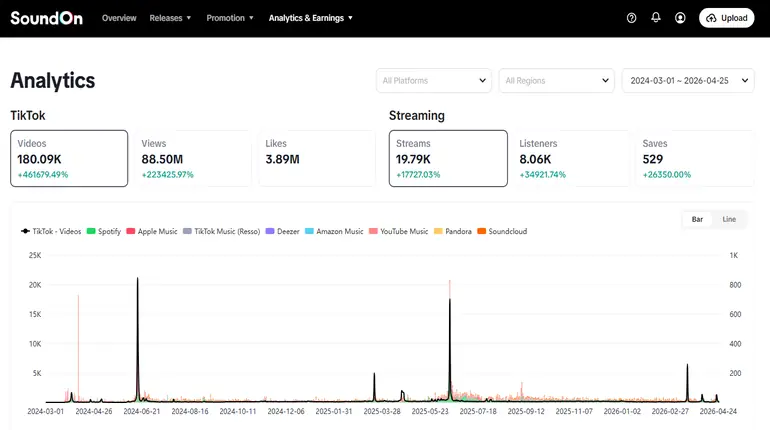
This didn't happen overnight. The views built up gradually across 2024 and into 2025. Some tracks got modest traction - 50,000 views, 100,000 views. Then I noticed one track had crossed 500,000. Then another. By mid-2025, I had a few tracks in the millions.
The pattern was strange. These weren't viral moments. The tracks were just... sitting on Spotify, YouTube Music, Apple Music, wherever SoundON had pushed them. And people were finding them. Not many people per track, but across 60 tracks over two years, it added up.
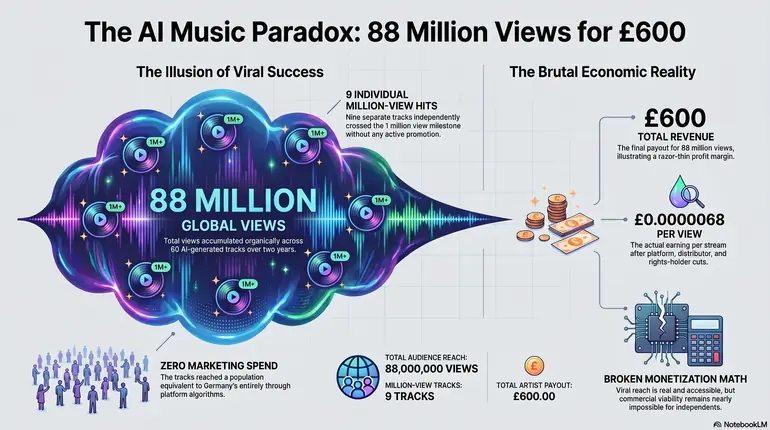
By early 2026, nine of them had crossed the 1 million view mark. Each. The total was approaching something I didn't expect to say: 88 million views.
At that point, I had to laugh. This was absurd. I'd uploaded AI-generated music I was genuinely embarrassed about, done zero promotion, and somehow ended up with a reach most independent artists would kill for.
Then I checked the earnings.
The Numbers
88 million views across 60 tracks. 9 tracks with over 1 million views each. The breakdown ranges from a few thousand on the duds to 8-9 million on the standouts.
From a reach perspective, this is legitimately impressive. Views aren't people, though, and the gap between the two is wide: one listener replaying a track fifty times counts as fifty views. So I've no idea how many actual humans heard any of this. What I can say is that over two years, AI-generated music I made for fun was played 88 million times.
Then reality hit.
The Punchline
I made £600.
Let that sink in. 88 million views. £600.
That's £0.00000682 per view. Or about £6.82 per million streams. Check the sum yourself: £600 divided by 88,000,000. The Spotify average you see quoted everywhere, $0.003 to $0.005 per stream (roughly £0.0024 to £0.004), is a payout to rights holders on a qualifying full-length stream, not a per-view rate that lands in an independent artist's account. Across 60 tracks scattered over Spotify, YouTube Music, Apple Music and the rest, platform cuts, distributor commission and a lot of short free-tier plays dragged my effective rate down to under a penny per thousand views.
SoundON takes a commission. Spotify, Apple Music, and the rest take their cuts. What's left is... not much. I could buy dinner. A decent dinner. Once.
The gap between 88 million and £600 is the gap between viral reach and actual commercial viability. One is real. The other is the punchline of this whole experiment.
Why You Won't Hear Them
The obvious question: "Can I listen?" The answer is no. I'm not sharing links or promoting these tracks. Two reasons.
First, they're genuinely embarrassing. I'm not being coy. The production is rough, the lyrics are questionable, and some of them sound like a fever dream. I made them for fun, not to build a brand or reputation. They've existed in the wild for two years accumulating views organically, but I'm not drawing attention to them.
88 Million Views Track
Example from the Suno experiment
Second, the legal landscape around AI-generated music is still murky. Copyright questions. Licensing uncertainty. Rights issues. Until there's more clarity on what you can and can't do with AI-generated content, I'm being cautious about actively promoting this work. The fact that the tracks are out there passively is one thing; me endorsing and marketing them is another.
The Actual Takeaway
If you're thinking about trying AI music generation, do it. Suno is accessible, it's fun, and it actually works. You can generate usable music without any musical training in minutes. That's genuinely novel. The same wave of generative AI ran through coding assistants and video models over the past year, and music is just one corner of it.
But understand what the numbers mean and what they don't. 88 million views sounds incredible until you check the payout. The monetization equation for independent artists on streaming platforms is fundamentally broken. You're not going to get rich. You're probably not going to make meaningful money at all.
What you might get is a creative tool that's genuinely fun to use, a record of what you can build in a few hours, and the knowledge that if it resonates with people, they'll find it. The reach is real. The money isn't.
Go in with eyes open, but it's worth the experiment.